.png)


Jyoti Patta: Documenting A Ritual Art of Kumaon
Studio Kaäla presents an ongoing effort to document, study, and restore Jyoti Patta (locally called Jyoonti) as a distinct ritual art form of the Kumaon region in Uttarakhand, India. This project seeks to recognize Jyoti Patta not merely as a subset of Aipan but as a parallel tradition with its own distinct techniques, visual vocabulary, material culture, and ritual purpose
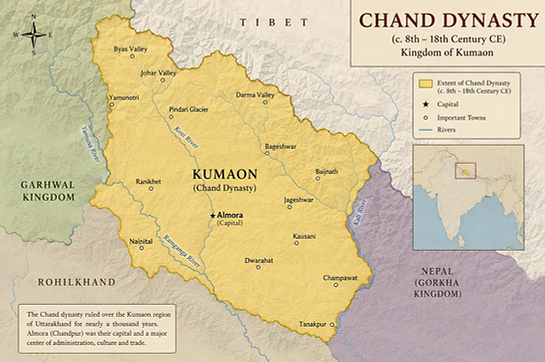
Emerging from the cultural milieu of the Chand dynasty (8th–18th century CE), it was historically painted by women on mud walls during ceremonies like weddings and thread rituals to invoke the blessings of the Matrikas (Lakshmi, Saraswati, and Kali).
While often associated with the broader Aipan art tradition, Jyoti Patta carries its own distinct iconography, compositional grammar, and ritual purpose. At its core, it is not just art but an offering. A visual invocation that transforms domestic spaces into sacred ground. Today, it survives largely through oral transmission and memory, making it one of the most vulnerable and under-documented expressions of Himalayan visual culture.

Reframing Jyoti Patta as a Women's Ritual Archive
Although often grouped under the broader Aipan tradition, Jyoti Patta shares only selective visual traits with it. Where Aipan encompasses a wide range of decorative and religious floor and wall drawings, Jyoti Patta is a specialized ceremonial painting, that are ritually created during sacred milestones such as weddings and thread ceremonies (janeu). What sets it apart is its role as a women-led ritual archive, a visual language practiced, preserved, and passed on by women, often without written record. By examining it through this focused lens, the project reveals Jyoti Patta as a living, gendered archive of spiritual, social, and artistic knowledge that deserves independent recognition.
A Tradition at Risk
Jyoti Patta is a living but endangered folk art, one that continues to survive mostly on the mud-plastered walls of mountain homes. Passed down orally and practiced by women, often without institutional recognition, this artform is representative of the disappearing labor of Himalayan women and a rapidly fading visual culture. Its fragility lies not only in the materials used (which fade, are washed off, or decay) but in the fact that it is held within memory, not manuals. As younger generations migrate or adopt modern lifestyles, fewer families maintain the custom, placing the tradition on the brink of cultural erasure.
What We Are Documenting?
This project is committed to developing an exhaustive cultural archive of Jyoti Patta through:
-
Technique: Capturing the step-by-step process, tools, gestures, pigments (like red geru and rice paste), and design logic involved in creating Jyoti Patta.
-
History: Tracing the origins and historical evolution of Jyoti Patta as a distinct visual culture emerging from the Chand dynasty period (c. 8th–18th century CE).
-
Practitioners: Interviewing women artists, particularly from Brahmin and Sah communities, who have preserved this practice across generations.
-
Material Culture: Studying surfaces (walls, cloth, plywood), pigment preparation, and transitions to modern media.
-
Oral Traditions: Recording stories, ritual songs, superstitions, and local beliefs tied to each motif and its placement.
-
Social Role: Understanding the function of Jyoti Patta in communal life, rituals, gender roles, and the spiritual architecture of Kumaoni homes.
-
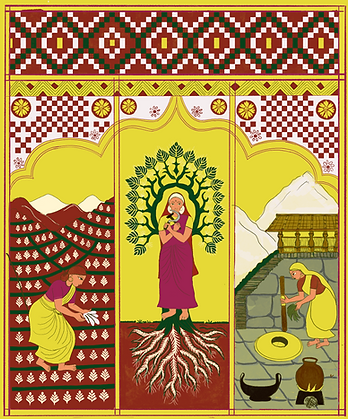
Aesthetics: Analyzing the layered iconography, such as the Matrikas, Kalpavriksha, Ganesha, and mountain peaks
Political History: Contextualizing Jyoti Patta within shifts in cultural policy, religious syncretism, caste systems, and post-colonial neglect of Himalayan folk arts.
Documenting Jyoti Patta is not merely about preservation; it is about reinstating visibility to a gendered, local, and spiritual knowledge system. It draws attention to the undocumented ritual labor of women, whose hands have ritualized countless life events without formal attribution or authorship. In doing so, it reclaims domestic space as a site of knowledge-making, and allows us to rethink what constitutes 'heritage' and who gets to be remembered as its custodian.
Call for Support: Open for Grant Funding
We are currently seeking grant funding to support the fieldwork phase of this project.
Primary costs include:
-
Travel across Uttarakhand to reach remote villages and artist communities
-
Interview logistics, including equipment, interpretation, and transcription
-
Documentation tools (photography, videography, archival digitization)
-
Translation and archiving of oral histories and ritual songs
This is an open call to institutions, patrons, cultural foundations, and independent supporters who value indigenous knowledge systems, feminist ethnography, and Himalayan visual culture.
We invite you to help ensure that the glow of Jyoti Patta does not fade from the walls of Kumaon without a trace.